The Evolution of Iraq's Basrah Crude Grades
Read in 4 minutes
[To read this post with more numbers and detail, clients can click here for the full note and potential clients may contact us here for a free two-month trial with no obligations.]
Petro-Logistics’ cargo level API information for southern Iraqi exports shows that while Basrah Medium and Heavy exports have remained elevated volumetrically, stable quality remains elusive.
Initially comprised solely of the Basrah Light grade, the Basrah complex of exports saw the introduction of a second grade in 2015 (Basrah Heavy) then a third grade in 2020 (Basrah Medium) before the removal of Basrah Light from international markets by January 2022. By introducing these new grades, the Iraqi State Oil Marketing Company (SOMO) aimed to remedy quality issues stemming from the increasing number of fields constituting the Basrah Light blend. When Basrah Light was removed, the barrels were allocated to a mixture of domestic usage and blending into the other export grades.
Upon the creation of Basrah Medium, SOMO released official API and sulphur content standards for the three grades. Once Basrah Light stopped being exported, Basrah Medium and Basrah Heavy barrels became lighter as they absorbed some of the Basrah Light volume. Medium and Heavy have since – on average – managed to broadly fit within their respective standards, but there has been a wide standard deviation when looking at the spread of individual cargoes.
The removal of Basrah Light from international markets did not have a significant impact on the total volume of Basrah grades exported, with all exported Basrah barrels decreasing only marginally with a 4.5% decline since 2018 coming in the face of rising domestic crude consumption.
In practical terms, Basrah Medium has replaced Basrah Light, but the volumetric split between Basrah Medium versus Basrah Heavy has changed slightly from Basrah Light days. Basrah Medium accounts for 64% of Basrah barrels so far in 2025 compared to Basrah Light representing 76% of the complex back in 2018.
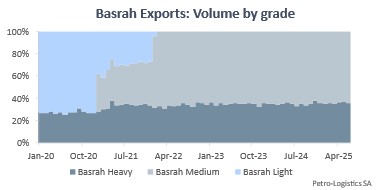
The reshuffling between the three grades without significantly changing the total volume has led to both Basrah Medium and Basrah Heavy getting lighter over time. Significant volumes of the previous Basrah Light barrels have been integrated into Basrah Medium, making it lighter. In turn some of the heavier barrels of Basrah Medium were transferred to Basrah Heavy, leading to its lightening and to a rise in volume.
Introduced with a specification of 27.9⁰ API in 2020, Basrah Medium averaged 28.3⁰ for the first six months of 2025. However, only 55% of the barrels were between 27.5⁰ and 28.5⁰. The grade’s density was similar in 2024, with an average API of 28.15⁰, with 70% of the volume falling between 27.5⁰ and 28.5⁰.
For Basrah Heavy, as its volumes increased it saw its API lighten from an average of 19.4⁰ in 2021 when all three grades were available, to 24.0⁰ in 2024 and now 24.3⁰ for the first half of 2025. However, more volume has not meant more variation in quality for Basrah Heavy.
Basrah Medium is now quite close in quality to Basrah Light as it existed before the introduction of Basrah Medium. Indeed, thus far in 2025, it is around a full API degree lighter than Basrah Light in 2020. Basrah Heavy is volumetrically larger than ever, but the added barrels have made the grade lighter.
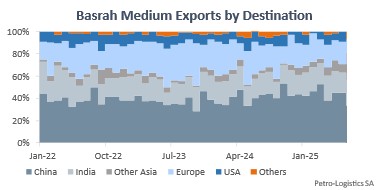
Directionally, flows of Basrah Medium surged into Europe and the Atlantic Basin in the wake of the conflict in Ukraine, but the Pacific Basin, and China specifically, remains the core market for the grade. Trade flow patterns have increasingly returned to their pre-war trends, with H1’25 volumes to Europe down 35% versus the 2023 peak, and flows to China up 20%. Indeed, China has been the number one buyer of Basrah Medium since its inception, purchasing at higher levels than when Basrah Light was exported. India has been a stable buyer of Basrah Medium, currently on par with Europe as a whole at 20% for H1’25.
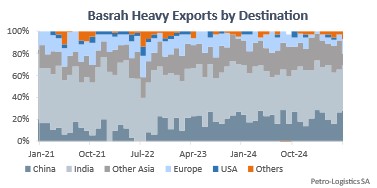
The changes in flows for Basrah Heavy have been more nuanced and appear to result from a combination of the war in Ukraine and possibly the lightening of the grade. India remains the top buyer but as the grade’s total volume has risen its share has shrunk from 52% in 2022 to 44% in H1’25.
The most striking changes in Basrah Heavy affected Europe and China. European buyers were attracted by the grade back in 2021, securing 16% of the exported volume. This was at the time when the grade was its heaviest, with an API gravity below 20⁰. But many regional players have since limited their purchase of the grade, despite an initial surge at the start of the Russia-Ukraine conflict. European destinations represent only 6% of Basrah Heavy barrels so far in 2025. On the other hand, China’s share has risen from a trough of 9% in 2022 to 23% in the first half of 2025.
Despite an initial rush of European buyers due to the Ukrainian war, the two key Iraqi grades are firm favourites of the Asian market, where most barrels land. Petro-Logistics will continue to monitor the quality, volume and destinations of Basrah grades.